Praying For the BEST! (Sermon Audio)

Praying For the BEST! (Sermon Audio)


This is the audio from the September 29, 2019 sermon, “Praying For the BEST!”, shared by Tom Lemler at the Deer Run Church of Christ.

Text: Philippians 1:9-11

Here are the main points from the sermon:

When it comes to praying for the best, ask God to give you His:

  • Benefits:
    • Psalms 103:2-5, Romans 6:22 —  While our culture has gradually changed the concept of employee benefits to being something that is earned or deserved, it hasn’t always been this way.  For many generations, the “benefit package” was something a company gave to benefit their employees in ways that were above and beyond what they earned.  I believe it is in that former context that we pray for, and receive, the best benefits a person could ever obtain.  These benefits are completely unearned and belong to all who come into relationship with God through His Son, Jesus Christ.  When we pray for the best benefits, we find that God is generous in supplying so much more than we could think or imagine because what He supplies will last for eternity.
  • Equipment: 
    • Ephesians 6:10-13, 2 Timothy 3:16-17 — At least in my life, and I suspect the same is true for many of you, much has been accomplished with whatever tools happened to be available when the work needed done.  What I’ve learned over the years, as better tools became available to me, is that using the best equipment generally yields a result that is far superior to most of my “make do” efforts.  As we live the Christian life, God has offered to equip us with the absolute best tools possible if we would only go to Him in prayer.  In fact, prayer itself is at the top of the list of the best equipment we can have in living a life of victory over the temptations of the evil one.  When we pray for the best equipment, God clothes us with His armor so that on the day of evil we may stand.
  • Strategy:
    • Isaiah 55:8-9, Psalms 119:1 — Growing up in a culture that has taught us that we not only can have it our way, but we deserve it our way, makes it difficult to accept that our way isn’t the best way.  Growing up on a farm I learned that it was possible to accomplish just about anything given enough time and determination.  Looking back I realize there were many things accomplished that took much more time and effort than they would have had to simply because I didn’t know the best way to do them.  Too often we settle for mediocrity, or worse, because we insist our ways and plans are somehow superior to anything else.  We will only experience the best when we realize and accept that God’s ways are so much better in every aspect than ours.  When we pray for the best strategy, we must begin from a position of listening with a blank slate rather than asking God to bless a strategy we have come up with either on our own or through observing others.
  • Testimony:
    • 1 John 5:9-12, John 4:39-42 — How people respond to what you say has a lot to do with how they perceive the authenticity of your testimony.  I suspect we have all received unsolicited advice throughout our life that we simply ignored because there was no evidence that the advice being given had in any way benefited the person giving it.  Our prayers for the best testimony begin to be answered when we accept the testimony of God about His Son, Jesus.  It is then through living out an authentic relationship with Jesus that we find our testimony about His working in our life is a powerful tool in helping others even have a desire to know Him.  When we pray for the best testimony God doesn’t make it more dramatic, He simply shows us how even the small details of our life have a purpose when we use them to share with others how we are a witness of God’s love and power.

Praying for the best will mean we truly want the best. When we pray for the Benefits, Equipment, Strategy, and Testimony that only God can give, we discover He has answered our prayer and filled us with the very best He has — His Son.

WORK That Matters! (Sermon Audio)

WORK That Matters! (Sermon Audio)


This is the audio from the September 1, 2019 sermon, “WORK That Matters!”, shared by Tom Lemler at the North Wayne Mennonite Church.


Text: John 6:28-29

Here are the main points from the sermon:

When it comes to having work that matters, make sure these elements matter in your work:

  • Worship that matters:
    • Romans 12:1 — When you present your body to God as a living sacrifice, your work — the things you do with your body — ought to become a big part of the worship you offer God.  Seeing the work that you do as an element of worshiping God helps you to see  your work as something that matters to God.  Learning to have worship that matters within all of your daily activities will go a long way toward helping others see Jesus in the midst of your daily work.  In seeking to have work that matters, find ways in all circumstances to have worship that matters.
  • Occupation that matters: 
    • Colossians 3:23-24 — “Whatever you do.”  While there are some tasks done by mankind that I believe are sinful and therefore should not be done by Christians (or anyone else for that matter), God’s desire is that whatever you do would be done for Him.  In the Kingdom workforce, there is work “created in advance” for each one of us to do.  Just as we have been created uniquely, the work God has for us to do will rarely be identical to the work He has for someone else.  Having work that matters isn’t nearly as dependent on finding the right occupation as it is in working our occupation with the proper attitude.
  • Rest that matters:
    • Hebrews 4:9-11 — Having work that matters will require us to have rest that matters.  When God chose to rest after the six days of creation, it wasn’t so much that He was worn out and needed it but rather it was to serve as an example of our need for rest.  While there are times we must press on even when we’ve become weary, being able to stop and rest at appropriate intervals will generally improve our ability to work in such a way that we believe our work matters.  In our culture today, we often have a tendency to fill our “non-work” hours with so much activity that real rest is rather elusive.  When we learn to have rest that matters, I believe  we will grow in having work that matters.
  • Knowledge that matters:
    • 2 Timothy 2:15 — We live in a time that I think could well be described as information overload.  It seems we are constantly being bombarded with sound bites and headlines that contain talking points of information but very little actual knowledge.  When Paul instructs Timothy to “study to show yourself approved”, it is in the context of being a worker who won’t be ashamed.  While our culture prides itself on having an ever-increasing base of knowledge, any knowledge that does not have the Word of God as its foundation tend to make a prideful people rather than a humble worker.   When we spend time fully digesting and putting into practice the Word of God, we set our self up to have work that matters because we have knowledge that matters.

Having WORK that matters isn’t really so much about what you do as it is about how you do it and who you do it for.  I believe you will find that as you fill your life with worship, occupation, rest, and knowledge that matters, you will discover great growth in your understanding and practice of work that matters.

2016: Page 31

It was back to work early this morning to finish cleaning and mopping so the building would be ready for church services.  This morning our Sunday School class finished up a study through the book of Job as we looked at the last few chapters where God addresses Job.  Because we know the story of Job and even have a glimpse at the backstory, it is easy to miss how much we tend to be like him as well as like his friends.  We want everything to have an answer and reason that is understandable to us.  When God’s working is a mystery, we often make up answers and reasons that we think make the most sense.  Unfortunately, this leaves us in the position of Job’s friends where we are of no help to those suffering and we give them the wrong impression of God.  

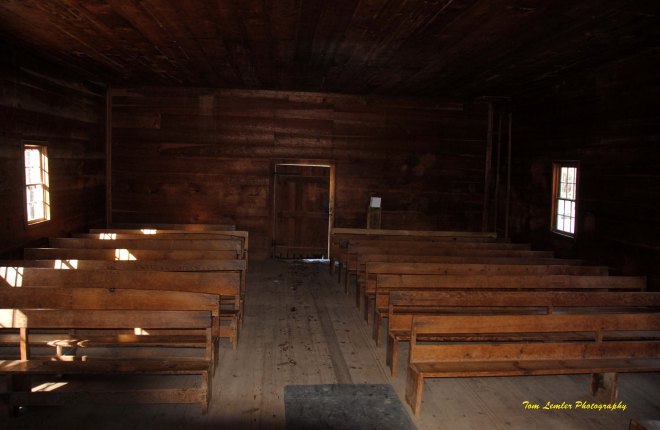
After Sunday School we had a good worship gathering as we gave praise to God through song, learned together from His Word, and gathered around the communion table to remember the death, burial, and resurrection of Jesus.  As I considered my recent trip to Cades Cove and my visit to several different church buildings from the 1800’s, I thought about the vast difference in the furnishings and equipment between then and now.  Sometimes it seems like the modern American church believes it can not function without the latest and greatest buildings, furnishings, and electronics.  While all of these things can be useful tools when used for God’s glory, they become idols when we give them more importance than we give God Himself.  Similarly, gathering with minimal “stuff” can be helpful in removing distractions that keep us from truly worshiping God but it too can become an idol when we begin to focus more on our simplicity and sacrifice than we do on God.  Worship shouldn’t be about our stuff or our lack of stuff — it ought to be solely about God!

As I prepared to close out the day, I was reminded of Paul’s words to the Corinthians, and to us: “For I resolved to know nothing while I was with you except Jesus Christ and him crucified.”  (1 Corinthians 2:2 NIV)

DSC_0684

Luke 18a: Always Take Time to PRAY


Sermon from the “Living Like Christ” series.


Luke 17b: Understanding the COME in “Thy Kingdom Come”


Sermon from the “Living Like Christ” series.


Luke 12b: Give What You OWE


Sermon from the “Living Like Christ” series.


2 Kings: Lesson 18 — Standing Your Ground!

The following are discussion questions from a weekly study I am leading through the book of 2 Kings.  We meet each Wednesday evening at the Deer Run Church of Christ.

The Unraveling of a Nation

A Study of the Book of 2 Kings

Lesson 18 (Standing Your Ground!)
2 Kings 18
May 7, 2014

The Text:

  1. How was Hezekiah’s life like that of the kings before him?  How was it different — what did he do that others hadn’t?  How does God describe him?
    –
  2. What was Hezekiah able to accomplish?  What was his interaction with the Assyrians and the Philistines?  What was happening in Israel while Hezekiah reigned in Judah?
    –
  3. In Hezekiah’s fourteenth year of reign, what did the king of Assyria do?  How did Hezekiah respond?  Did Hezekiah’s actions satisfy Sennacherib, king of Assyria?  
    –
  4. What message did Sennacherib send to Hezekiah?  What did Sennacherib’s message say about his view of Hezekiah’s actions in removing the high places and altars throughout Judah?  What did Hezekiah’s men ask the messenger to do?  Why?  What was the response? 
    –
  5. What message did Sennacherib’s commander want the people of Jerusalem to hear?  What did he offer them?  What did he say about Hezekiah’s message to the people that “The Lord will deliver us.”?  What did the people do?  Why?

The Application:

  1. Are there things in your life, or the life of your family, which have become accepted that God would want you to remove?  How do/would you know?  What would it take in your life for God to say (in a good way) that there is none like you? 
    –
  2. How much credit do you give to God for any success that you have?  Would you do anything different in/with your life if you believed God would make those efforts successful?  How do you feel when you see people around you fall to the enemy? 
    –
  3. When you face attack or hardship, do you consider you may have done something wrong?  How likely are you to make an attempt of peace with those you have wronged?  Does your best efforts of peace mean peace will happen?         
    –
  4. Have people ever misunderstood your worship of God?  Are there times when people seem to think you ought to worship God in a way that is different that what God says?  Have you ever spoken things publicly in order to intimidate/humiliate someone when you should have talked to them privately?      
    –    
  5. Are there people around you who try to make you doubt God’s ability to save?  Are there times the enemy tempts us today with ease and comfort if we just go along with him?  How do you respond?

Next Week:   Praying to a Powerful God
2 Kings 19


2 Kings: Lesson 17 — Enough is Enough!

The following are discussion questions from a weekly study I am leading through the book of 2 Kings.  We meet each Wednesday evening at the Deer Run Church of Christ.

The Unraveling of a Nation

A Study of the Book of 2 Kings

Lesson 17 (Enough is Enough!)
2 Kings 17
April 30, 2014

The Text:

  1. How is Hoshea’s way of life described . . . Is it good or bad?  Why did the king of Assyria set out to attack Hoshea?  Who had Hoshea turned to?  What did the king of Assyria do?  How long did it take?  What was done with the people of Israel?
    –
  2. Why did the things from the first question happen?  What were some of the specific things the Israelites had done?  How had God warned the people?  How did the people respond?  Who did the people use for an example of how to live?
    –
  3. How did God feel about Israel following the example of other nations?  What did he do about it?  What influence had Israel had on Judah?  How did God respond to that?
    –
  4. What did the king of Assyria do with the towns of Samaria after he had taken the Israelites captive?  What did God do to the people living in the towns?  Why?  What conclusion was told to the king of Assyria?  What response did the king have?
    –
  5. Even after being taught to worship the Lord, what each national group that was brought into Israel do?  Did they follow the instruction given on how to worship the Lord?  What did they do?  Who does this sound like?

The Application:

  1. How good is “good enough”?  How do you know?  Have you ever made a commitment that you later changed your mind about?  Would God think there are times when you have turned to others even after you’ve given your allegiance to Him?  In what ways?  What should we do?
    –
  2. How much attention do you pay to God’s Word when you go about your daily activities?  Are there warnings in God’s Word that you know you ignore?  Why do we tend to justify and keep doing things we know God has said not to?
    –
  3. Are you different in the way you act and talk according to who’s around you?  Does the misbehavior of fellow Christians influence what you determine is appropriate and right?
    –
  4. When you remove something inappropriate from your life, do you pay attention to what takes its place?  Do you ever suffer simply because you didn’t know better?  What should be done in those circumstances?
    –
  5. Where do you get your instruction on how to worship the Lord?  Are we more likely to look at how others worship, or look at how God wants us to worship?


Next Week:   Standing Your Ground
2 Kings 18